All God's children got rhythm -- and at a much earlier age than doctors ever suspected, a small study shows.
Studying children's sense of musical timing has long been challenging. The babies in the study...

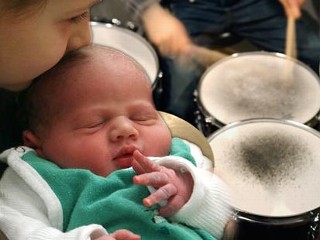
Studying children's sense of musical timing has long been challenging. The babies in the study couldn't even grab their toes, let alone tap them. Yet brain scans show that these 2- and 3-day-olds could perceive musical patterns and even take note when a drummer missed a beat, the study in today's Proceedings of the National Academy of Sciences shows.

(ABC News Photo Illustration)
Studying children's sense of musical timing has long been challenging. The babies in the study couldn't even grab their toes, let alone tap them.
Yet brain scans show that these 2- and 3-day-olds could perceive musical patterns and even take note when a drummer missed a beat, the study in today's Proceedings of the National Academy of Sciences shows.
The 14 babies, who were examined under their mothers' watchful eyes, had similar patterns of electrical brain activity as 14 adults in the study, says co-author Henkjan Honing of the University of Amsterdam. The scans revealed that the infants were following the beat and, like any music listener, began to expect the drummer to continue the same pattern.






 Study Suggests Babies Get the Beat at Birth


 Linear Mode

